
Stonex GNSS Receivers
S1000 · S980+ BE · S880
Base, rover or network RTK
Set up for GDA2020
The range
Three receivers, three different jobs
S1000
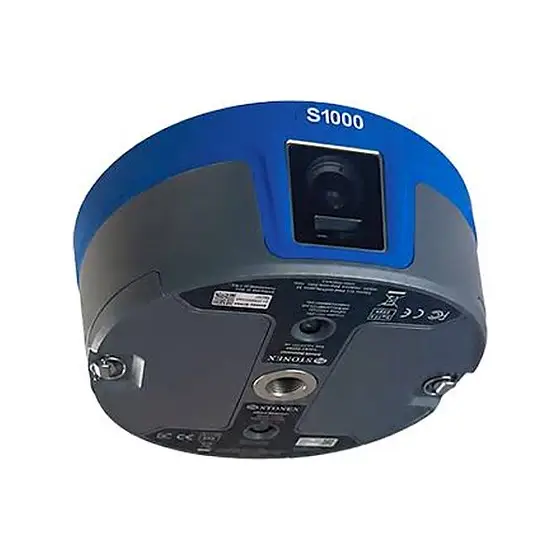
The most capable of the three. Two cameras, an integrated laser distance meter, 50 Hz positioning and two hot-swap batteries.
Buy it if you regularly need points you cannot physically stand on, or you want image records of what you measured.
S980+ Black Edition
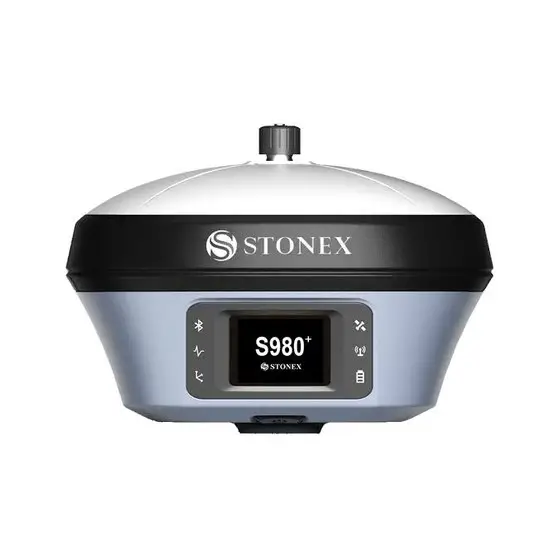
Built to be left running. Adjustable 2–5 W UHF, colour touch display, external antenna port, 1PPS output and around 15 hours on internal battery.
Buy it if you are setting up your own base, or feeding corrections to machine control on site.
S880
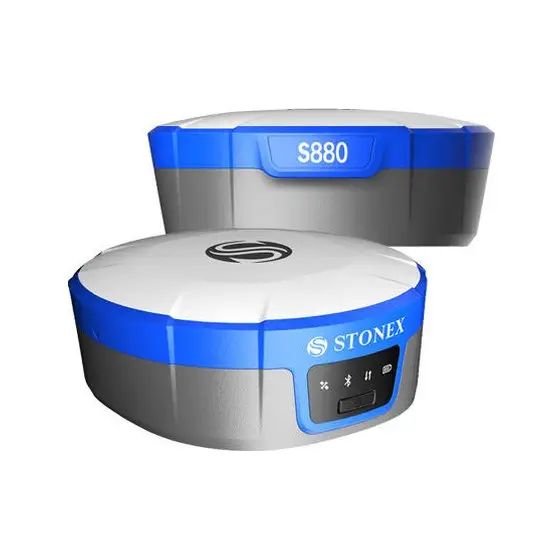
Compact, light and IP68, with a stakeout camera, IMU tilt and a 2 W radio. Rated to a 1.5 m drop.
Buy it if you want a rover that survives a working site and does not cost flagship money.
What a setup actually consists of
Stonex S1000
Measure the things you cannot stand on
Laser distance measurement
An integrated laser lets the receiver compute a coordinate for a point it is aimed at rather than occupied. Combined with the IMU, that turns unreachable and unsafe points into ordinary observations.
How accurate the derived point is depends on range, incidence angle and how well the receiver knows its own attitude. It is not the same as standing on the point, and it should not be treated as such for control.
Two cameras
One camera drives AR stakeout, overlaying direction and distance to the target on a live view. The front camera is intended for photogrammetry, so you can pick coordinates off captured imagery.
Useful for as-built records and dispute evidence. Photogrammetric points are a documentation tool, not a substitute for a measured pickup.
Two hot-swap batteries
Both batteries are removable and can be changed one at a time without powering the receiver down. On a long day that removes the mid-afternoon reinitialise, which is the actual productivity gain.
UHF plus LoRa
A 2 W UHF radio in the 410–470 MHz band alongside LoRa. Both are radio transmissions, and both are subject to Australian spectrum rules — see the section below before you assume you can switch either on.
Stonex S980+ Black Edition
The one you leave running
Adjustable 2–5 W UHF
Output can be wound up or down to suit the site rather than run flat out. Turning power down when you do not need range is good practice, and on a licensed frequency it is often a licence condition.
External antenna port
Connect a permanent antenna and the receiver becomes a fixed reference rather than a tripod base — the route to a site CORS or a semi-permanent yard reference.
Colour touch display
Status, mode and corrections are visible on the receiver itself. Trivial until a base has been running unattended for a week and someone needs to check it without a controller.
1PPS timing output
A one-pulse-per-second output for synchronising other equipment to GNSS time. Relevant if you are integrating with data loggers, monitoring gear or machine systems that need a common clock.
Around 15 hours
A large internal battery, and mains or external power for longer sessions. A base that dies at 2pm costs you the afternoon for every machine and rover depending on it.
IMU is an option, not standard
Tilt compensation on the S980+ is an activation rather than something every unit ships with. If you intend to use it as a rover as well as a base, confirm it is included in your quote.
Stonex S880
The rover that goes out every day
Stakeout camera
A downward camera gives live visual assistance finding the point, which makes stakeout noticeably faster for anyone who is not doing it every day.
IMU tilt to 60°
Automatic pole tilt compensation, so you are not levelling a bubble at every shot. Read the tilt section below before you rely on it for control.
IP68 and 1.5 m drop
Rated for dust and water ingress and for a drop from pole height. This is the specification that matters most on a real site, and the one most often skipped over.
20 Hz positioning
Lower than the S1000’s 50 Hz. For a person walking with a pole this makes no practical difference. It matters on moving platforms.
8 GB memory
Plenty for logging static sessions and raw data. The S1000’s 32 GB only matters if you are logging long static observations or storing imagery on the receiver.
2 W radio and 4G
Works as a rover off your own base or off a correction network, and can act as a base itself when you need it to.
Before you transmit
Australian spectrum rules apply to your base
The 900 MHz option needs the same care. Some Stonex radios cover 902.4–928 MHz. In Australia the low interference potential devices class licence covers 915–928 MHz, not the whole of that range. A radio left on its factory band plan can sit partly outside what the class licence permits.
We configure receivers to an appropriate Australian band plan before they leave us, and we will tell you plainly whether your intended setup needs an apparatus licence and help you through the application. If a supplier hands you a base station and says nothing about any of this, ask them why.
Corrections
Two ways to get centimetres
Your own base gives you independence from mobile coverage and from a subscription, which matters on a remote job or in a pit where reception drops out. It also ties you to a licence, a radio path and a piece of equipment that has to be set up correctly on a known mark every day.
Network RTK removes all of that and replaces it with a monthly fee and a dependency on mobile signal at the point you are standing on. On urban civil work that trade is usually worth making. In a pit, often not.
Tilt compensation
What tilt to 60° actually means
Side by side
Published specifications
| S1000 | S980+ BE | S880 | |
|---|---|---|---|
| Channels | 1408 | 1408 | 1408 |
| Constellations | GPS, GLONASS, Galileo, BeiDou, QZSS, IRNSS, SBAS | ||
| Position rate | Up to 50 Hz | Up to 20 Hz | Up to 20 Hz |
| IMU tilt | Integrated | Optional activation, to 60° | Integrated, to 60° |
| Internal memory | 32 GB | 8 GB | 8 GB |
| UHF radio | 2 W, 410–470 MHz, plus LoRa | 2–5 W adjustable, 410–470 MHz | 2 W |
| Cellular / comms | 4G, Wi-Fi, Bluetooth | 4G, Wi-Fi, Bluetooth | 4G, Wi-Fi, Bluetooth |
| Cameras | Two, plus laser distance meter | None | One stakeout camera |
| Display | — | Colour touch display | — |
| Battery | Two hot-swap | Internal, around 15 h | Internal |
| Ingress protection | IP68 | IP67 | IP68 |
| Operating temperature | −40 °C to +65 °C | −40 °C to +65 °C | −40 °C to +65 °C |
| Drop rating | — | 2 m pole drop | 1.5 m |
| Other | AR stakeout, photogrammetry | 1PPS port, external antenna port | AR stakeout |
Choosing
Which one, honestly
What you get from us
Supplied set up, not just shipped
Configured before it ships
Licensing sorted
Checked against a known mark
Trained on your workflow
Supported and repaired locally
Questions
Frequently asked
To receive satellite signals, no. To operate a base station transmitting corrections over UHF, yes — that needs an ACMA apparatus licence. Working as a rover off a correction network over 4G does not require a radio licence. Tell us how you intend to work and we will tell you which applies.
Yes. An S980+ BE base feeding corrections to machine-guided plant and a rover for check shots and conforms is a common setup, and it means one correction source and one coordinate system across survey and machines. Talk to us about the whole site rather than the receiver on its own.
Usually. These receivers output standard formats and pair over Bluetooth or Wi-Fi. Compatibility depends on your specific field software and how you want to work, so tell us what you are running and we will confirm before you order rather than after.
It depends on sky view, baseline length, correction source and how the pole is held — far more than on which of these three you buy. Published figures assume good conditions. Describe your site and we will give you a realistic expectation rather than the number on the brochure.
Yes, it has a 2 W radio and can broadcast. The S980+ BE is the better base because of the adjustable output, the display, the external antenna port and the battery life. If you only occasionally need a base, an S880 may be enough; if the base is a permanent part of your setup, buy the one built for it.
Not meaningfully, for a pole held on a point. Both use the same 1408-channel board and track the same signals. The S1000 gives you a laser, cameras, more memory, a faster position rate and hot-swap batteries. Those are capability differences, not accuracy differences, and it is worth being clear about that before you spend the money.
Yes, across Australia and New Zealand, with our technical and repair base in Brisbane.
Talk to us. We also repair Hemisphere GNSS equipment in-house, so if your existing gear is repairable rather than obsolete we will say so instead of selling you a replacement.