
Slew & Height Limiters
Slew, height, radius & depth limits
Proportional hydraulic cut
Exclusively distributed by Red Edge
What it is
Intelligent Motion Control
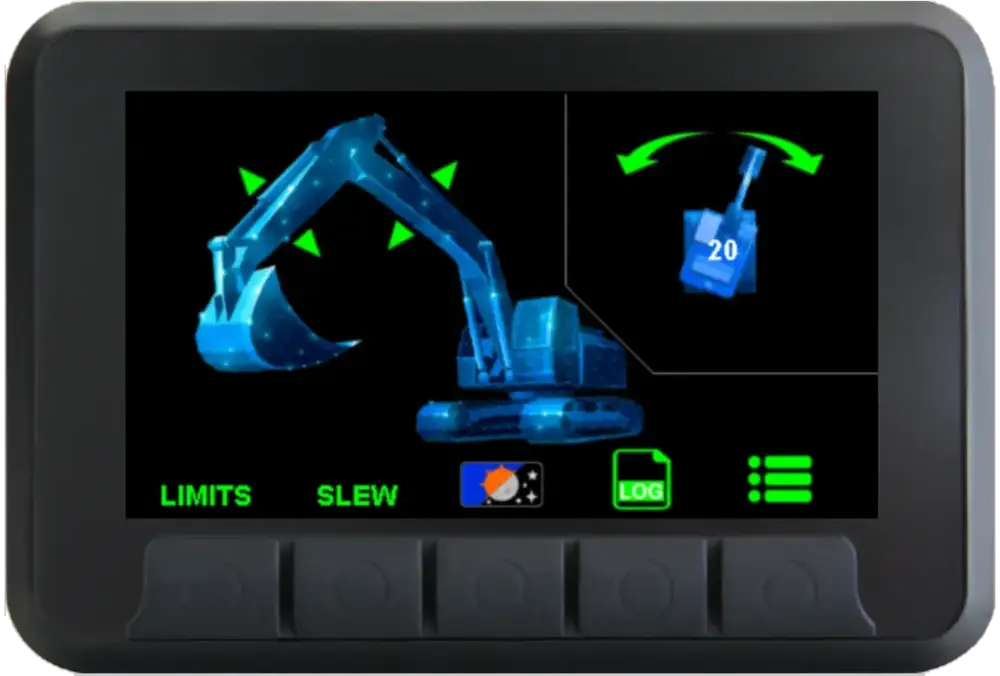
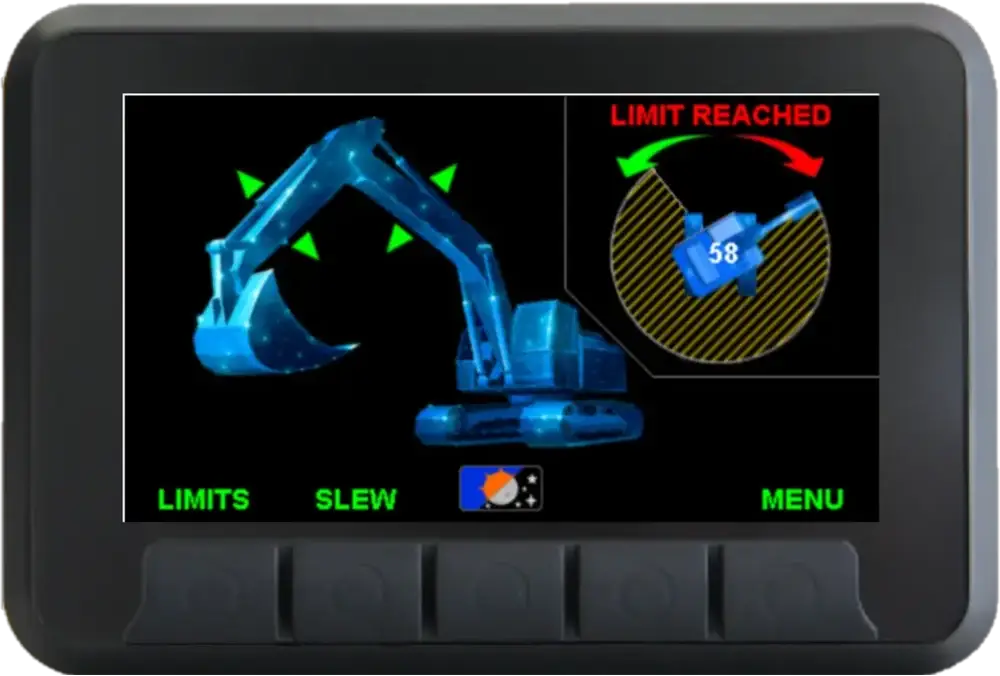
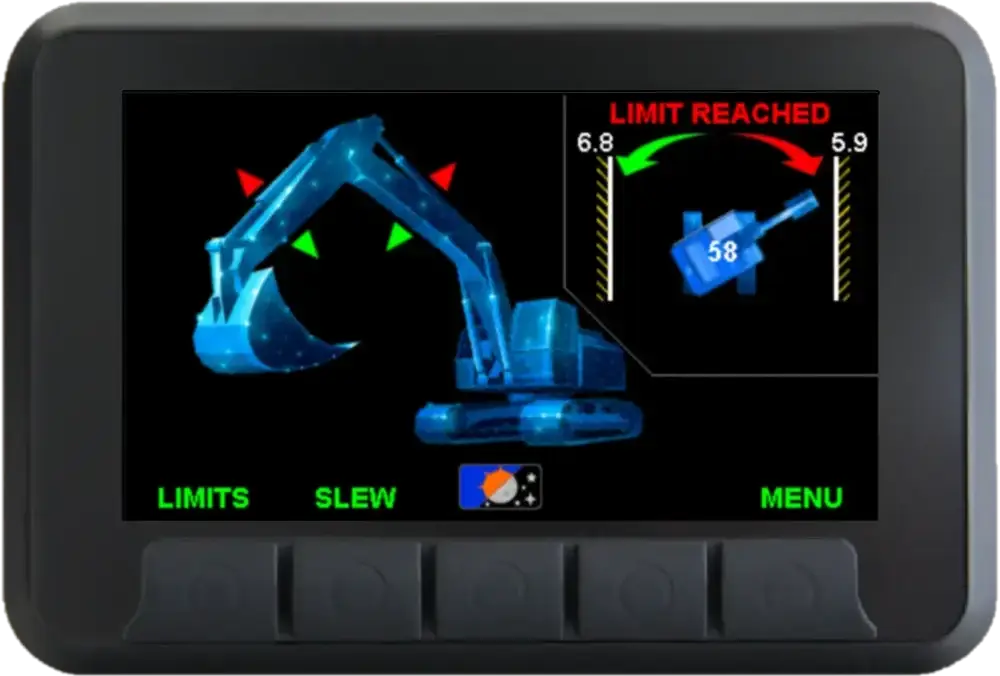
Gyro-assisted angle sensors track the boom and arm. A slew sensor tracks rotation. When any of those approach a programmed limit, proportional cut valves ramp the relevant function down and stop it. The operator sees why on a 4.3″ colour touchscreen, and every event is logged.
Red Edge Resources is the exclusive Australian distributor. We specify the configuration for your machine and your site, fit it, commission the limits against the distances your electricity entity or principal contractor has given you, and support it from Brisbane.
Why this matters
Procedures are not a control. The regulator has said so.
The incidents behind that notice are the ones every operator recognises. A drill rig slewed with the boom raised near an 11,000 V line and the operator watched the electricity arc across. A 40 tonne excavator walking a dam access road pulled down 11,000 V lines and started a bushfire. A crane contacted a SWER line after the safety observer stepped away to control traffic on the access road.
That last one is the whole argument. The spotter was competent, the procedure existed, and the procedure required the spotter to be watching. He was doing something else for a minute. An engineering control does not step away.
This is not only a mining question. The same logic applies on civil sites, in rail corridors, in demolition and anywhere a principal contractor is being asked what physically prevents an incident rather than what discourages one.
Where the envelope goes
Set it outside all three zones
Overhead electric lines in Australia are surrounded by a layered set of zones: a no-go zone at the conductors, an exclusion zone around that, and a safety observer zone outside both. The distances depend on the voltage, on which state you are in, and on whether a trained safety observer has been appointed.
We do not guess at those distances and neither should you. Get them in writing from your electricity entity — Energex, Ergon, Ausgrid, Endeavour, SA Power Networks, Western Power or whoever holds the asset — and we will programme the envelope to sit outside them with margin. If someone offers to set your limits without asking who the electricity entity is, that should worry you.
Be clear on this before you buy
What a motion limiter does, and what it does not
It does
- Physically stop boom, arm and slew before they cross a limit you have programmed
- Ramp the function down proportionally rather than stopping dead, so the machine is not shock-loaded
- Show the operator which limit they are approaching, on screen and by voice
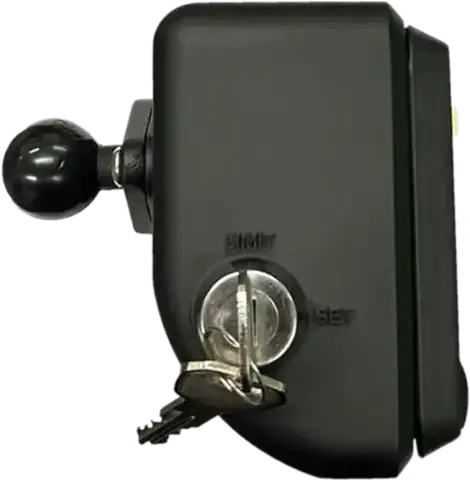
- Log every limit event and every override, with a supervisor key controlling who can change settings
- Work in the dark, in dust, and when the operator is tired or distracted
- Give a principal contractor something demonstrable to point at in an audit
It does not
- Detect anything. It knows its own geometry — not where the powerline, structure or person is
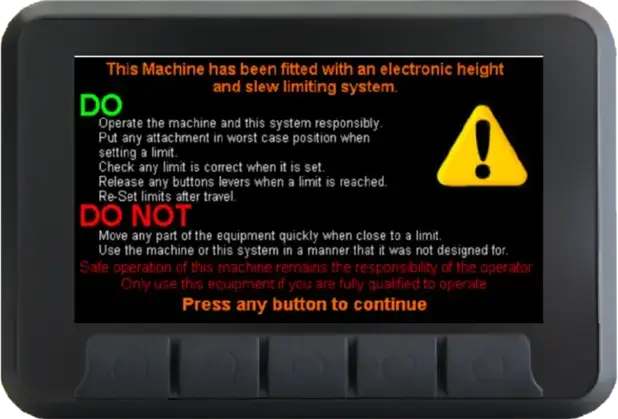
- Know that you have tracked the machine. Move it and the limits move with it — the start-up screen below says to re-set them after travel
- Stop instantly. A heavy attachment slewing at speed carries momentum into the ramp-down
- Remove the need for a safety observer where your electricity entity or regulator requires one
- Replace de-energising or relocating the line, which sit above it in the hierarchy of control
- Protect you from a limit that was set wrong. It will enforce a bad envelope precisely and confidently
What it enforces
Six limits, all measured from the machine
Configurations
Two levels
Height limiter
Height limiting only, with the same proportional hydraulic control and the same data logging as the full system.
Right when the hazard is purely overhead — a powerline crossing, a bridge soffit, a conveyor, a roof structure — and rotation is not the risk.
Height and slew limiting
Adds point-to-point slew limiting, virtual walls, dig depth, cab protection, maximum radius and iVoice spoken messages.
Right when the hazard has a direction — a live rail corridor beside you, a road, an adjacent building, an occupied structure, a shared work area.
Gyro-assisted angle sensors
Proportional cut valves
4.3″ colour touchscreen
Supervisor key switch
Event logging
iVoice spoken messages
Rail corridor
A configuration built for working next to live track
Motion limiting
Proximity detection
Machine state monitoring
Attachment selection
Applications
Where it earns its place
Overhead powerlines
Live rail corridors
Urban and confined sites
Demolition
Tunnels and low clearance
Lifting duties
How we deploy it
The commissioning is the product
Establish the real distances
Specify for the machine and the attachment
Install and integrate
Commission and physically prove each limit
Train the operators on the caveats
Set up the review
Questions
Frequently asked
Not automatically, and do not assume it. Where your electricity entity, regulator or principal contractor requires a safety observer, a limiter does not remove that requirement. What it does is stop the outcome depending entirely on one person staying focused. Treat it as an additional engineering control, and get any reduction in other controls agreed in writing by whoever set them.
Yes, through an emergency override, and it needs to be possible — a machine stuck against a limit in a bad position is its own hazard. But overrides are logged, and changing the limits themselves requires the supervisor key. The system makes bypassing visible rather than impossible, which is the right design; what matters is that someone reads the log.
The limits are measured from the machine, so they travel with it. A slew limit or virtual wall set at one standing position is not valid once the machine has moved. Webbair say so themselves: the IMC start-up screen instructs the operator to re-set limits after travel. Making that part of the work method is not optional, and it is the thing we spend most of the operator training on. Talk to us about how your crews work so we can set this up to suit.
No, and you would not want it to. The proportional valves ramp the function down into the limit. That means there is a deceleration distance, which grows with slew speed and attachment weight. We account for it when we set the envelope, which is part of why the limits are commissioned with your actual attachment fitted rather than calculated on paper. The start-up screen also tells operators not to move quickly when close to a limit, for the same reason.
Send us the clause. Requirements for plant near powerlines and live rail vary between authorities, states and contractors. We will read it and give you a straight answer about whether this configuration meets it, including where it does not and what else you would need.
It is designed for versatile fitment across excavators, cranes and loaders. Whether it suits your specific machine depends on the hydraulic system and how the controls are arranged, so tell us the make, model and year and we will confirm before quoting rather than after.
It varies with the machine and how many limits are being fitted, because the valves integrate into the hydraulic circuits. Commissioning and proving every limit takes real time on top of the fitting, and we would rather quote that honestly than surprise you. Ask us for a time estimate on your specific machine.
Yes, across Australia and New Zealand, with our technical and repair base in Brisbane.