Stonex GNSS Receivers

Survey-grade RTK positioning for civil, mining and machine control work. Supplied, configured and supported in Australia by Red Edge Resources.

S1000  ·  S980+ BE  ·  S880

Base, rover or network RTK

Set up for GDA2020

The range

Three receivers, three different jobs

Stonex build a wide GNSS line-up. We concentrate on three, because between them they cover almost everything an Australian civil or mining crew actually needs, and because we would rather support three receivers properly than list twelve.
All three run the same 1408-channel GNSS board and track every current constellation, so raw satellite performance is not what separates them. What separates them is the radio, the display, the memory, the cameras and what they are physically built to sit on all day. Pick on the job, not on the spec sheet.
Flagship rover

S1000

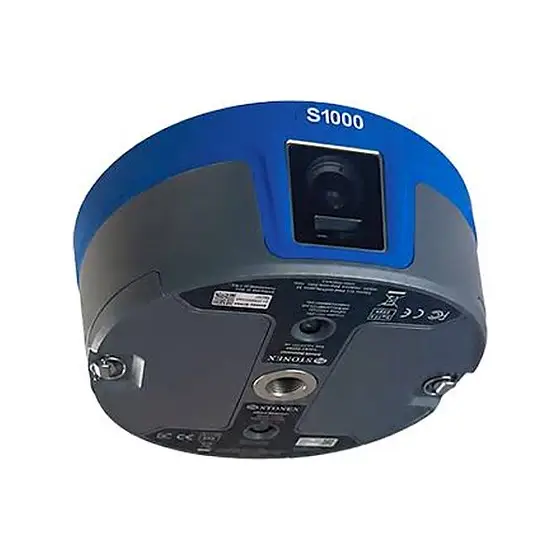
The most capable of the three. Two cameras, an integrated laser distance meter, 50 Hz positioning and two hot-swap batteries.

Buy it if you regularly need points you cannot physically stand on, or you want image records of what you measured.

Base station

S980+ Black Edition

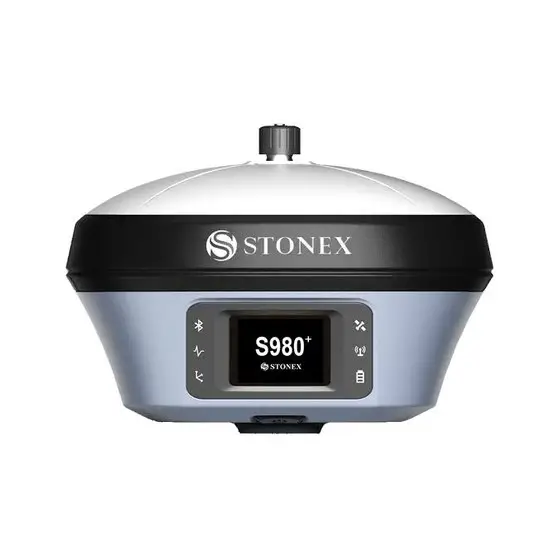
Built to be left running. Adjustable 2–5 W UHF, colour touch display, external antenna port, 1PPS output and around 15 hours on internal battery.

Buy it if you are setting up your own base, or feeding corrections to machine control on site.

Everyday rover

S880

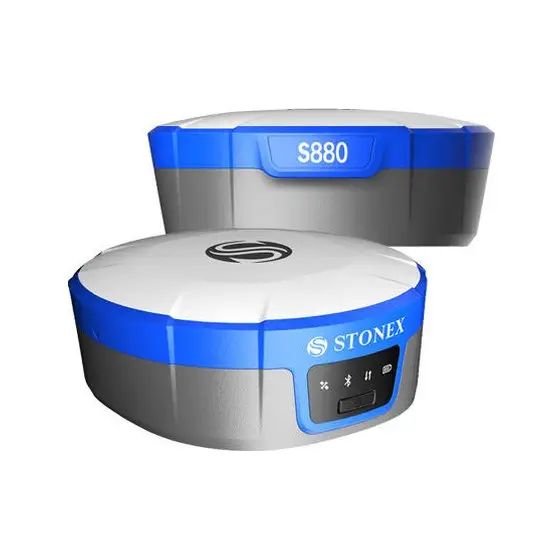
Compact, light and IP68, with a stakeout camera, IMU tilt and a 2 W radio. Rated to a 1.5 m drop.

Buy it if you want a rover that survives a working site and does not cost flagship money.

What a setup actually consists of
A receiver is one part of a working kit. This catches people out at quote stage, because two prices for “an S880” can mean very different boxes arriving.
What a base setup and a rover setup consist of Left: a base station — tripod, tribrach, receiver and a UHF antenna on a side mast. Right: a rover — receiver on a survey pole with a bipod and a field controller on a bracket. Schematic, not to scale. BASE SETUP Base receiver Tribrach Tripod UHF antenna on a side mast Set up over a mark of known coordinates ROVER SETUP Rover receiver Carbon pole Bipod Field controller Pole bracket Carried; corrections by radio or 4G A receiver on its own is not a working setup. Check what a quote includes before you compare prices. Schematic — not to scale
Base and rover, schematically. Drawn generically rather than as a likeness of any particular model — Stonex do not publish full dimensions for all three receivers, and we would rather show you an honest diagram than an invented rendering. Ask us for a full kit list against whatever you are comparing us to.
S1000Shown from below — the camera aperture sits beside the mount
S980+ Black EditionThe colour display is the give-away — built to be read on the tripod
S880Compact enough to carry all day, IP68 and rated to a 1.5 m drop
Manufacturer product images. Not shown to a common scale — Stonex do not publish full dimensions for all three.

Stonex S1000

Measure the things you cannot stand on

The S1000 is the receiver you buy when a plain rover keeps failing you — the point is behind a fence, over water, up a face, or inside a live traffic lane.

Laser distance measurement

An integrated laser lets the receiver compute a coordinate for a point it is aimed at rather than occupied. Combined with the IMU, that turns unreachable and unsafe points into ordinary observations.

How accurate the derived point is depends on range, incidence angle and how well the receiver knows its own attitude. It is not the same as standing on the point, and it should not be treated as such for control.

Two cameras

One camera drives AR stakeout, overlaying direction and distance to the target on a live view. The front camera is intended for photogrammetry, so you can pick coordinates off captured imagery.

Useful for as-built records and dispute evidence. Photogrammetric points are a documentation tool, not a substitute for a measured pickup.

Two hot-swap batteries

Both batteries are removable and can be changed one at a time without powering the receiver down. On a long day that removes the mid-afternoon reinitialise, which is the actual productivity gain.

UHF plus LoRa

A 2 W UHF radio in the 410–470 MHz band alongside LoRa. Both are radio transmissions, and both are subject to Australian spectrum rules — see the section below before you assume you can switch either on.

Stonex S980+ Black Edition

The one you leave running

Most receivers can be made to work as a base. The S980+ BE is designed for it, and the difference shows on the third day of a job rather than the first.

Adjustable 2–5 W UHF

Output can be wound up or down to suit the site rather than run flat out. Turning power down when you do not need range is good practice, and on a licensed frequency it is often a licence condition.

External antenna port

Connect a permanent antenna and the receiver becomes a fixed reference rather than a tripod base — the route to a site CORS or a semi-permanent yard reference.

Colour touch display

Status, mode and corrections are visible on the receiver itself. Trivial until a base has been running unattended for a week and someone needs to check it without a controller.

1PPS timing output

A one-pulse-per-second output for synchronising other equipment to GNSS time. Relevant if you are integrating with data loggers, monitoring gear or machine systems that need a common clock.

Around 15 hours

A large internal battery, and mains or external power for longer sessions. A base that dies at 2pm costs you the afternoon for every machine and rover depending on it.

IMU is an option, not standard

Tilt compensation on the S980+ is an activation rather than something every unit ships with. If you intend to use it as a rover as well as a base, confirm it is included in your quote.

Note the IP rating difference. The S980+ BE is IP67. The S1000 and S880 are IP68. In practice all three handle rain and dust on site; the distinction matters if a receiver is going to spend time submerged or under sustained pressurised water, which is unusual for a base on a tripod but worth knowing.

Stonex S880

The rover that goes out every day

The S880 is the sensible default. It does the work most crews actually do — set out, pick up, conform — in a package that is light enough to carry all day and tough enough to survive being dropped off the back of a ute.

Stakeout camera

A downward camera gives live visual assistance finding the point, which makes stakeout noticeably faster for anyone who is not doing it every day.

IMU tilt to 60°

Automatic pole tilt compensation, so you are not levelling a bubble at every shot. Read the tilt section below before you rely on it for control.

IP68 and 1.5 m drop

Rated for dust and water ingress and for a drop from pole height. This is the specification that matters most on a real site, and the one most often skipped over.

20 Hz positioning

Lower than the S1000’s 50 Hz. For a person walking with a pole this makes no practical difference. It matters on moving platforms.

8 GB memory

Plenty for logging static sessions and raw data. The S1000’s 32 GB only matters if you are logging long static observations or storing imagery on the receiver.

2 W radio and 4G

Works as a rover off your own base or off a correction network, and can act as a base itself when you need it to.

Camera stakeout on the S880. Open this widget in Elementor and replace REPLACE-VIDEO-ID in the YouTube URL, or delete the widget if you are not using a video.

Before you transmit

Australian spectrum rules apply to your base

This is the part most receiver pages leave out, and the part most likely to cause you a problem. A GNSS receiver is free to listen to satellites. A base station broadcasting corrections over UHF is transmitting, and transmitting in Australia is regulated.
Operating a UHF GNSS base station in Australia needs an ACMA apparatus licence. The 400 MHz band is managed spectrum. Specific channels have been set aside for area-wide DGPS use, and the band moved to 12.5 kHz channel spacing, with segments reserved for government use. A receiver that arrives configured for a European or North American frequency plan is not automatically legal to transmit on here. This is not a formality — it is Commonwealth law under the Radiocommunications Act 1992.

The 900 MHz option needs the same care. Some Stonex radios cover 902.4–928 MHz. In Australia the low interference potential devices class licence covers 915–928 MHz, not the whole of that range. A radio left on its factory band plan can sit partly outside what the class licence permits.

We configure receivers to an appropriate Australian band plan before they leave us, and we will tell you plainly whether your intended setup needs an apparatus licence and help you through the application. If a supplier hands you a base station and says nothing about any of this, ask them why.

Corrections

Two ways to get centimetres

Any of these three receivers will work either way. Which one suits you is a question about your site, not about the hardware.
Two ways of getting RTK corrections to a rover Left panel: your own base station broadcasting corrections over UHF radio to a rover, which needs an ACMA apparatus licence. Right panel: a CORS network delivering corrections over the mobile internet by NTRIP, which needs mobile coverage and a subscription but no radio licence. OWN BASE + UHF RADIO RTCM Your base Rover Works with no mobile coverage Range limited by terrain and power Transmitting needs an ACMA licence NETWORK RTK OVER 4G CORS network NTRIP Rover No radio licence needed Needs mobile coverage at the point Needs a correction-service subscription All three receivers support both. Most Australian crews end up running one of each, not one or the other.
Where the corrections come from. The choice drives your licensing, your running costs and what happens when you drive out of mobile coverage. It does not change which receiver you buy — all three do both.

Your own base gives you independence from mobile coverage and from a subscription, which matters on a remote job or in a pit where reception drops out. It also ties you to a licence, a radio path and a piece of equipment that has to be set up correctly on a known mark every day.

Network RTK removes all of that and replaces it with a monthly fee and a dependency on mobile signal at the point you are standing on. On urban civil work that trade is usually worth making. In a pit, often not.

Tilt compensation

What tilt to 60° actually means

All three receivers offer IMU tilt compensation. It is a real productivity gain and we recommend it. It is also routinely oversold, so here is the geometry.
How pole tilt and attitude error affect the measured point A survey pole shown vertical and tilted at 30 and 60 degrees about a fixed ground tip. The further the pole is tilted, the further the antenna sits from the point, and the more any error in the receiver’s sense of its own attitude is magnified at the tip. Vertical 30° 0.50 L 60° 0.87 L The point you want WHAT TILT ACTUALLY COSTS The tip is computed, not measured. The antenna knows where it is. Where the tip is depends on the receiver’s sense of its own attitude. Error at the tip scales with pole length. An attitude error of 1° on a 2 m pole is about 35 mm at the tip. On a 2.5 m pole it is about 44 mm. Steeper tilt, less margin. Tilt is a productivity feature, not free accuracy. For control points, stand the pole up.
Tilt is geometry, not magic. Tilting the pole moves the antenna away from the point, and the receiver computes its way back. Any error in how well it knows its own attitude is multiplied by the pole length before it reaches the tip.
Use tilt for volume, not for control. Topo pickup, kerb and channel, service locations, conform surveys — tilt earns its keep. Setting out control, boundary marks, or anything that will be relied on downstream, stand the pole up and let it sit. The receiver will not stop you doing otherwise, which is exactly why the decision has to be yours and deliberate.

Side by side

Published specifications

Manufacturer figures, current at the time of writing. Confirm the exact configuration in your quote — options and band plans vary, and we would rather you check than assume.
S1000 S980+ BE S880
Channels 1408 1408 1408
Constellations GPS, GLONASS, Galileo, BeiDou, QZSS, IRNSS, SBAS
Position rate Up to 50 Hz Up to 20 Hz Up to 20 Hz
IMU tilt Integrated Optional activation, to 60° Integrated, to 60°
Internal memory 32 GB 8 GB 8 GB
UHF radio 2 W, 410–470 MHz, plus LoRa 2–5 W adjustable, 410–470 MHz 2 W
Cellular / comms 4G, Wi-Fi, Bluetooth 4G, Wi-Fi, Bluetooth 4G, Wi-Fi, Bluetooth
Cameras Two, plus laser distance meter None One stakeout camera
Display — Colour touch display —
Battery Two hot-swap Internal, around 15 h Internal
Ingress protection IP68 IP67 IP68
Operating temperature −40 °C to +65 °C −40 °C to +65 °C −40 °C to +65 °C
Drop rating — 2 m pole drop 1.5 m
Other AR stakeout, photogrammetry 1PPS port, external antenna port AR stakeout
Figures compiled from Stonex published product data and dealer specifications, August 2026.
On accuracy figures. Published RTK accuracies for this class of receiver are typically quoted around 8 mm + 1 ppm horizontal and 15 mm + 1 ppm vertical, under good sky and a short baseline. Those are laboratory-grade conditions. Under canopy, beside a highwall, next to a building face or on a long baseline you will not see them, and any supplier quoting a single accuracy number without stating the conditions is quoting marketing. What we can tell you is what to reasonably expect on your site, once we know what your site looks like.

Choosing

Which one, honestly

S880
Start here
For most civil crews this is the right receiver. If you are buying your first survey-grade GNSS, or replacing a rover that is doing ordinary set-out and pickup, the S880 does that work as well as anything above it. Spending more will not make your set-out more accurate.
Most crews
S980+ BE
Add when you need your own base
Buy this as the second receiver, not the first, unless you are specifically standing up a base or a site reference. Paired with an S880 rover it is a complete base-and-rover setup, and it is the one to feed corrections to machine control.
Base + rover
S1000
Buy for the laser and cameras, not the badge
The GNSS performance is not meaningfully better than the S880 for a person standing on a point. What you are buying is the laser, the imagery and the hot-swap batteries. If you will not use those, the extra money is better spent on a second rover, a controller, or training.
Specific need
If none of the above describes you, say so. There are other receivers in the Stonex range we can supply, and there are jobs where a total station or a scanner is the right tool and GNSS is not. We would rather point you sideways than sell you the wrong instrument.

What you get from us

Supplied set up, not just shipped

01

Configured before it ships

Radio band plan set for Australia, correction profiles built for however you receive them, and coordinate system set to GDA2020 with the right transformation for your work. A receiver on the wrong datum produces confident, precise, wrong answers.
02

Licensing sorted

We tell you whether your intended setup needs an ACMA apparatus licence, and help with the application if it does.
03

Checked against a known mark

Verified on a mark of known coordinates before handover, so you start from a demonstrated result rather than a factory assumption.
04

Trained on your workflow

Training on the jobs you actually do and the software you actually use, not a generic walkthrough. Including what the receiver will not do.
05

Supported and repaired locally

Technical support by phone and email, and an in-house repair facility in Brisbane. Field kit gets damaged; the question is how long you are without it.

Questions

Frequently asked

To receive satellite signals, no. To operate a base station transmitting corrections over UHF, yes — that needs an ACMA apparatus licence. Working as a rover off a correction network over 4G does not require a radio licence. Tell us how you intend to work and we will tell you which applies.

Yes. An S980+ BE base feeding corrections to machine-guided plant and a rover for check shots and conforms is a common setup, and it means one correction source and one coordinate system across survey and machines. Talk to us about the whole site rather than the receiver on its own.

Usually. These receivers output standard formats and pair over Bluetooth or Wi-Fi. Compatibility depends on your specific field software and how you want to work, so tell us what you are running and we will confirm before you order rather than after.

It depends on sky view, baseline length, correction source and how the pole is held — far more than on which of these three you buy. Published figures assume good conditions. Describe your site and we will give you a realistic expectation rather than the number on the brochure.

Yes, it has a 2 W radio and can broadcast. The S980+ BE is the better base because of the adjustable output, the display, the external antenna port and the battery life. If you only occasionally need a base, an S880 may be enough; if the base is a permanent part of your setup, buy the one built for it.

Not meaningfully, for a pole held on a point. Both use the same 1408-channel board and track the same signals. The S1000 gives you a laser, cameras, more memory, a faster position rate and hot-swap batteries. Those are capability differences, not accuracy differences, and it is worth being clear about that before you spend the money.

Yes, across Australia and New Zealand, with our technical and repair base in Brisbane.

Talk to us. We also repair Hemisphere GNSS equipment in-house, so if your existing gear is repairable rather than obsolete we will say so instead of selling you a replacement.

Tell us the work, not the model number

Describe the jobs you do, how you get corrections, and what you are running now. We will tell you which of these three fits, whether you need a base at all, and what it will take to get you licensed and working.
Phone
Based in
Brisbane, Queensland
Servicing
Australia & New Zealand