Stonex machine control
Same millimetres.
Different
price tag.

Exclusive Australian distributor
Excavators · Dozers · Graders
1D, 2D and 3D
Fitted & supported locally

Why Stonex
The price gap isn’t
a quality gap
Machine control has been sold in this country as a premium fleet purchase for twenty years. A contractor with three machines gets quoted a number that only makes sense for a contractor with thirty — so the three-machine contractor keeps chasing stakes, keeps over-digging, and keeps paying for it in a way that never shows up as a line item.
Stonex is a global surveying and positioning manufacturer. The receivers track the same constellations, the RTK corrections are the same corrections, and the inclination sensors measure the same angles. Accuracy is a function of satellite geometry, baseline length and sensor quality — not the badge on the display.
What you give up isn’t accuracy. It’s part of the ecosystem: fewer third-party integrations, a smaller software estate, and less of the enterprise fleet-management layer that most contractors never switch on. If your work genuinely needs that layer, we’ll say so.
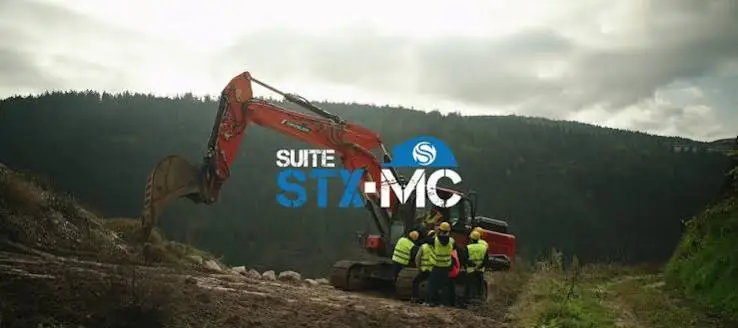
The range
What actually goes
on the machine
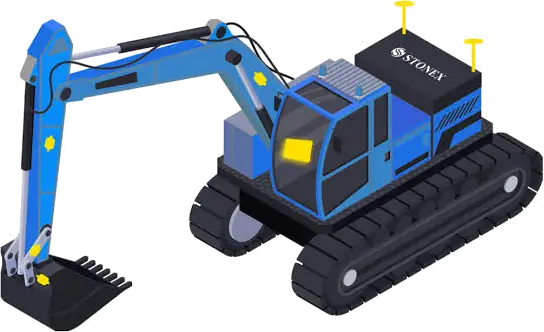
STX-DIG 2D
STX-DIG 3D
STX-DOZER
SMC-ONE GNSS
APOLLO tablet
Inclination & CAN bus
Base station or network RTK
2D now, 3D later
Excavators
STX-DIG
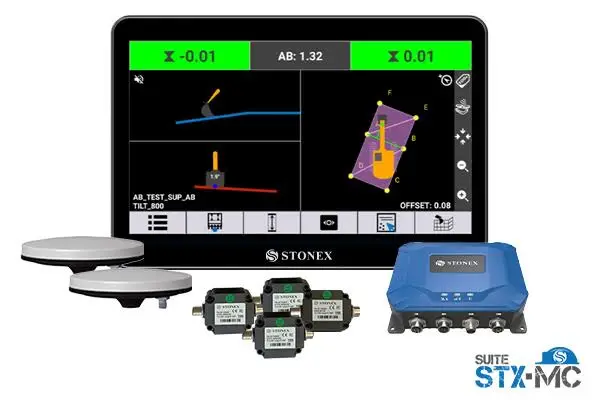
The operator can see
where the design is
Without guidance, an operator digs to a stake, a string line and a memory of what the supervisor said this morning. They dig a bit deep because deep is safer than shallow, and the extra material gets excavated, loaded, carted and replaced with product that has to be bought.
With STX-DIG, depth and slope are on screen in real time. The bucket tip position updates as the machine moves, the target is drawn against it, and the operator stops when it says stop — not when it looks about right.
- Real-time bucket tip position for depth, slope and trench profile, updated as the boom moves
- Design surface on screen in 3D mode, so the operator works to the model rather than to set-out
- Colour-coded cut and fill — the guidance is readable at a glance, which matters when the operator is also watching the trench
- Seamless switching between modes as the work changes across a site
- Suits foundations, utilities, drainage, batters and final trim — the work where over-excavation costs the most
Dozers & graders
STX-DOZER
Cut and fill on screen,
every pass
Bulk earthworks, haul roads, building pads, final trim. The blade position is tracked against the design and shown to the operator continuously, so the pass either takes material off or it doesn’t — there’s no second guess and no waiting for a surveyor to confirm.
The mode scales with the job. Simple slope work runs in 1D or 2D without corrections. A haul road or a pad built to a model runs in 3D on GNSS. Same hardware on the machine, different configuration.
- Real-time blade position against target grade, with colour-coded cut and fill indicators
- 1D, 2D and 3D modes selected to suit the job rather than the invoice
- Fewer passes to grade, which is fuel, hours and wear rather than an abstraction
- Consistent finish across operators — the gap between your best operator and your newest one narrows considerably
- Fits existing dozers and graders, including older machines still doing real work
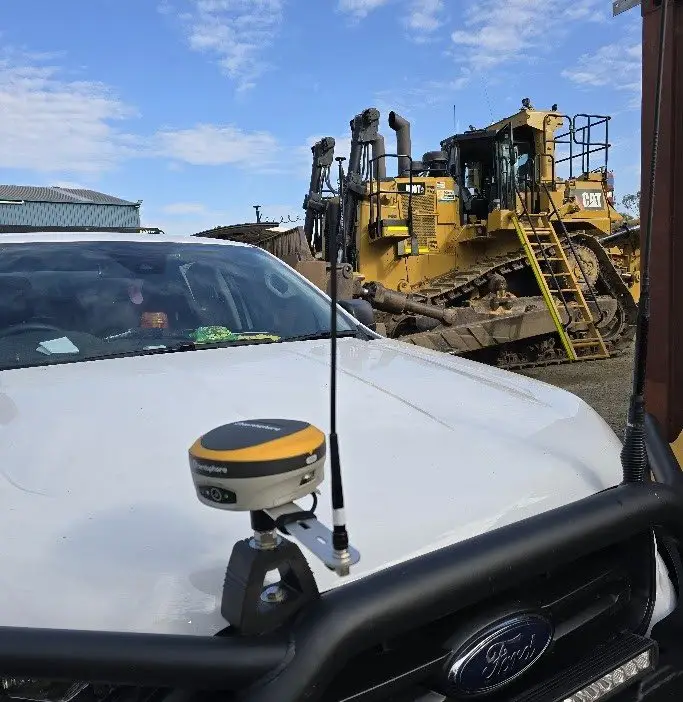
Choosing
2D or 3D
| 2D | 3D | |
|---|---|---|
| What it knows | Angles. Depth and slope relative to a point you set on the machine. | Position. Where the bucket or blade is on the site, against a design model. |
| What you need | Sensors and a display. Nothing outside the machine. | The same, plus a GNSS receiver and RTK corrections — your own base or a network subscription. |
| Best for | Trenching to depth, batters, footings, drainage falls, single-level pads. | Bulk earthworks, haul roads, multi-level sites, anything issued to you as a model. |
| Where it stops | Someone has to establish the reference, and re-establish it every time the machine moves. | Needs corrections. In a deep pit or under heavy canopy, coverage has to be planned rather than assumed. |
| Rough guide | Start here ifmost of your work is trenches and levels, and a surveyor already visits the site. | Start here ifyou’re handed design files, or you’re moving volume across a site that changes shape. |
What it costs
Priced so a small
fleet can say yes
Ways to pay for it
that suit a project cycle
Most contractors don’t reject machine control on the total price. They reject it on the timing — a capital outlay that lands before the job that justifies it has been won. So there’s more than one way to structure it.
- Flexible payment terms arranged around project cycles rather than a fixed schedule
- Rent-to-purchase for project-based work, so a single job can carry the cost
- Trade-in programmes when you’re moving off older equipment
- Volume pricing where you’re fitting several machines at once
- Staged fleet rollout — fit two machines, run them for a quarter, then decide about the rest
Getting it fitted
From quote to
working machine
Scope
Install
Calibrate
Train
Support
Common questions
Before you call
For the positioning itself, yes — RTK GNSS accuracy is determined by satellite geometry, baseline length and receiver quality, and Stonex receivers are competitive on all three. The honest difference is in the surrounding ecosystem: fewer third-party integrations and a smaller enterprise software layer. That matters on a tier-one site with an established fleet platform. On most civil and mid-tier mining work, it doesn’t.
Yes, and it’s often the sensible order. The sensors, display and cabling stay; you add GNSS and corrections when the work calls for it. Tell us at the scoping stage that you’re likely to upgrade and we’ll fit it so the upgrade is a half-day rather than a re-install.
Not necessarily. If you’re in range of a CORS network and staying a while, a subscription is usually cheaper and simpler. If you’re remote, moving often, or need control that doesn’t depend on someone else’s uptime, your own base makes more sense. It’s a real cost comparison and we’ll do it with you rather than default to selling the hardware.
Almost certainly. These systems are designed to retrofit to existing excavators, dozers and graders, including older machines. Send us the make, model and year and we’ll confirm before you commit to anything — including telling you if a particular machine is going to be awkward.
We start remotely, because a good share of faults are configuration, firmware or a setting, and a phone call beats a two-day trip. Where hardware has genuinely failed we use genuine Stonex parts, and we make cables here rather than ordering them in — which turns a freight problem into a same-week one.
That’s a deliberate part of how we set it up. The STX-DIG Installation Masterclass is a self-paced program covering installation, calibration and testing, with certification at the end. A client whose fitters can handle their own installs and common faults gets far more out of the technology than one who waits on us.
Tell us what
The machines, the work, and what’s costing you time. We’ll tell you which Stonex configuration suits it, what it costs fitted and calibrated, and whether it’s worth doing at all. A demonstration on one of your machines is usually the fastest way to settle it.