
Stonex Total Stations
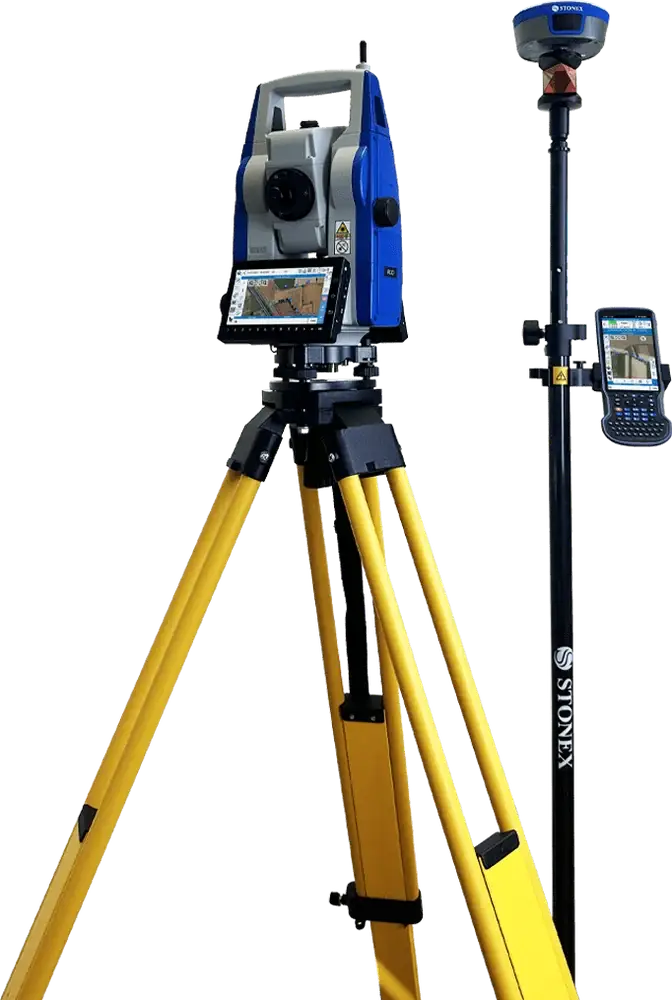
Robotic · R180 R120 R80
Manual · R60 R35 R25 R20
Buy or hire
The range
Seven instruments, one real decision
Stonex build both. The robotic instruments — R180, R120, R80 — motorise the head, lock onto a prism and let one person run the whole job from the pole. The manual instruments — R60, R35, R25, R20 — are pointed by hand and need someone on them. Within each group the differences are range, angular accuracy, the software platform and how well the housing is sealed.
Red Edge Resources is the Australian Stonex distributor. We supply the whole range, hire it out, set it up for the way you work, and repair it here rather than shipping it overseas.
Robotic
One person, one instrument
R180
0.5″ / 1″ / 2″ · 6000 m prism · 180°/sec
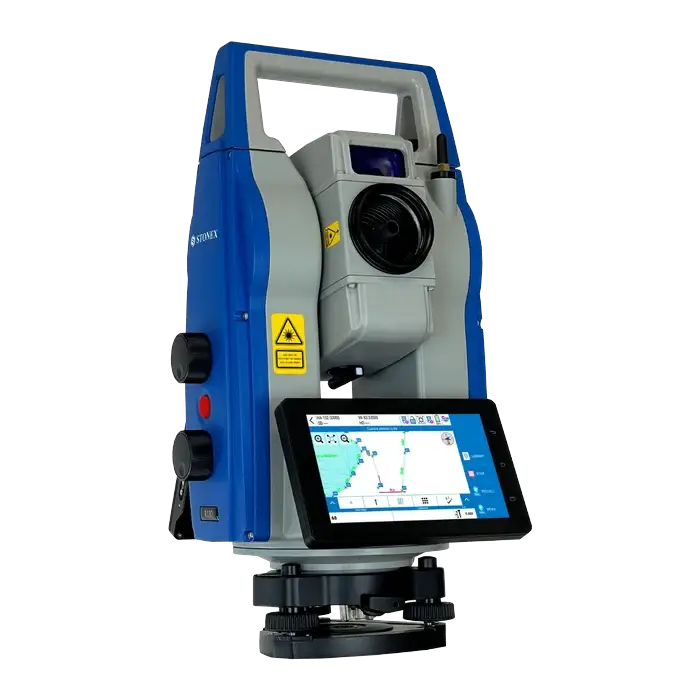
The fastest and longest-reaching in the range, and the only robotic model rated IP65. Direct drive rather than gears, so it is quiet, smooth and has less to wear out. Android with Cube-a on board, camera and light guide.
Buy it if you are chasing a prism on a moving machine, working long lines, or running the instrument every day in dust.
R120
1″ / 2″ / 5″ · 3500 m prism · 60°/sec
The cheapest way into robotic. Same 1 mm + 1 ppm EDM as the R180 and the same Android and Cube-a platform, with automatic prism centring and a 5.5-inch touchscreen. Shorter prism range and a third of the rotation speed.
Buy it if you want one-person operation on normal-length sight lines and do not need the R180’s speed.
R80
0.5″ / 1″ · 5000 m prism · 35°/sec
Sub-arcsecond angles and a quadruple-axis compensator, aimed at structural monitoring and high-precision layout. Tracks a prism moving at up to 50 km/h.
Note the platform. The R80 runs Windows CE 7.0, not Android and Cube-a. If you want one software environment across your total station and GNSS, that matters — see the honesty section below.
Manual
Pointed by hand, and none the worse for it
R60
1″ / 2″ · 5000 m prism · 1000 m reflectorless
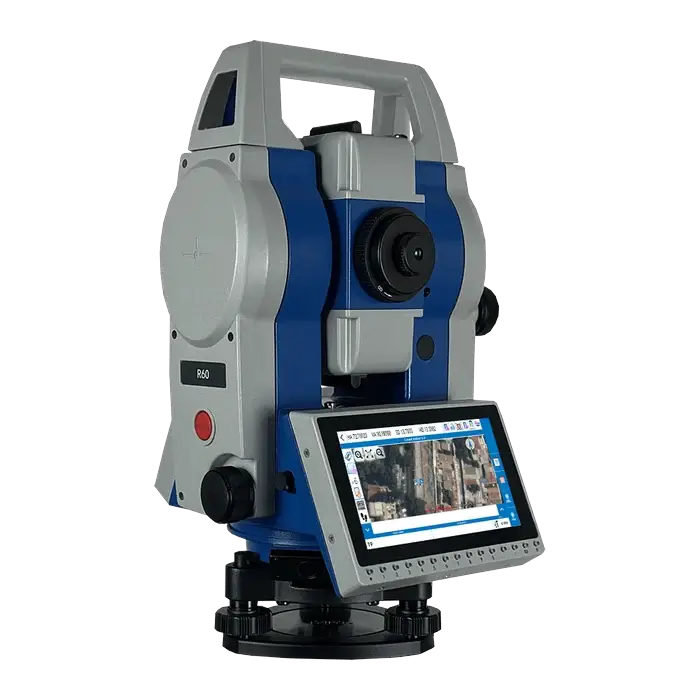
A 5.5-inch touchscreen running Android 11 with Cube-a, so it behaves like the robotic instruments and shares the same jobs and workflows. A GNSS connector on the handle lets you sit a receiver on the instrument’s vertical axis for mixed total station and GNSS surveys.
The 1″ version has lock drives; the 2″ has endless drives. Choose on how you like to work, not just on the angle spec.
R35 / R35LR
2″ · 5000 m prism · 600 m or 1000 m reflectorless
Endless friction drives and a trigger key, with dual touchscreens. The distinguishing feature is that you are not locked to the manufacturer’s software — FieldGenius, SurvCE and others run on board.
Buy it if your crew already knows a particular field package and you would rather not retrain everyone. That is worth real money and it is usually ignored.
R25 / R25LR
2″ · 5000 m prism · 600 m or 1000 m reflectorless
Friction drives, trigger key, dual-axis compensator and onboard software covering stakeout, COGO, reference line and road work. Around 12 hours on a battery.
Cadastral, mapping, staking, straightforward monitoring. Does the ordinary work without fuss.
R20
1″ / 2″ · 5000 m prism · 600 m or 1000 m reflectorless
The entry point, and quietly one of the most sensible instruments here for Australian conditions: IP65 and more than 22 hours of battery, both better than several instruments above it. Dual colour displays, illuminated reticle, absolute encoders, Bluetooth to an external controller.
Buy it if the instrument lives on a dusty site, gets handed between people, and needs to work all week without a charger.
Reach
How far each one actually measures
Prism range is the dependable number. Every instrument here reaches at least 3.5 km to a single prism, and in practice you will run out of clear line of sight, patience or atmosphere long before you run out of EDM.
Reflectorless is the number to be careful with. It is quoted against a good target square-on to the beam. Aim at dark, wet or oblique rock and the usable range drops sharply. If reflectorless range is the reason you are choosing one model over another, tell us what you will be shooting at and we will give you a realistic figure rather than the catalogue one.
Robotic or manual
The question is wages, not millimetres
What the spec sheet leaves out
Four things worth knowing before you compare numbers
Total station or GNSS
They are not competing, they are complementary
Reach for the total station
- Under canopy, beside buildings, in a cut — anywhere sky view is poor
- Indoors, in tunnels, under structures
- When you need the tightest relative accuracy across a small site
- Structural and slope monitoring, where repeatability from a fixed setup is the point
- Vertical work — a total station beats GNSS on height, comfortably
- When there is no correction source and no mobile coverage
Reach for GNSS instead
- Open ground with clear sky
- Large areas where line of sight would mean setup after setup
- Bulk topo and conform pickup where speed beats last-millimetre accuracy
- Feeding corrections to machine control
- Anywhere the instrument cannot see the point but a satellite can
Side by side
Published specifications
| R180 | R120 | R80 | R60 | R35 / LR | R25 / LR | R20 | |
|---|---|---|---|---|---|---|---|
| Type | Robotic | Robotic | Robotic | Manual | Manual | Manual | Manual |
| Angular accuracy | 0.5″ / 1″ / 2″ | 1″ / 2″ / 5″ | 0.5″ / 1″ | 1″ / 2″ | 2″ | 2″ | 1″ / 2″ |
| Prism range | 6000 m | 3500 m | 5000 m | 5000 m | 5000 m | 5000 m | 5000 m |
| Prism accuracy | 1 mm + 1 ppm | 1 mm + 1 ppm | 2 mm + 2 ppm | 2 mm + 2 ppm | mm class | 2 mm + 2 ppm | 2 mm + 2 ppm |
| Reflectorless | 800–1000 m | 800–1000 m | 1000 m | 1000 m | 600 / 1000 m | 600 / 1000 m | 600 / 1000 m |
| Reflectorless acc. | 2 mm + 2 ppm | 2 mm + 2 ppm | 3 mm + 2 ppm | 3 mm + 2 ppm | mm class | 3 mm + 2 ppm | 3 mm + 2 ppm |
| Rotation speed | 180°/sec | 60°/sec | 35°/sec | — | — | — | — |
| Drives | Direct, gearless | DC servo | Gear drive | Lock or endless | Endless friction | Friction | Lock |
| Platform | Android, Cube-a | Android 11, Cube-a | Windows CE 7.0 | Android 11, Cube-a | Your choice | Onboard | Proprietary |
| Comms | BT, Wi-Fi, 4G | BT, Wi-Fi, 4G | BT | BT, Wi-Fi | BT | BT | BT |
| Displays | Two, colour | 5.5″ touch | Two, 3.5″ touch | 5.5″ touch | Two, touch | Two | Two, colour |
| Ingress rating | IP65 | IP55 | IP55 | IP55 | — | IP55 | IP65 |
| Battery life | — | — | ~8 h | — | — | ~12 h | 22 h+ |
Hire
You do not always need to own one
Hire makes sense when
The instrument is for one project rather than a workload. You need a second unit for a few busy weeks. You are covering a repair. Or you want to run a robotic instrument on a real job before committing to buying one.
Buying makes sense when
The instrument is out most weeks. Past a certain number of days a year, hire costs more than ownership and you have nothing at the end. Tell us the days and we will do that arithmetic with you honestly, even where it points at hire.
What comes with it
Instrument, tripod, prism and pole, controller and charger — a working setup, not a box with a head in it. Configured for your coordinate system before it leaves, with phone support while you have it.
What you get from us
Set up, checked, and repairable here
Configured before it ships
Checked against known distances and angles
Trained on your jobs
Serviced and repaired in Brisbane
Questions
Frequently asked
No. Robotic means motorised and self-pointing, not more precise. The R20, a manual instrument, is available in 1″ and matches instruments costing considerably more on angle. What robotic buys you is one-person operation, faster stakeout and the ability to chase a moving prism.
If the instrument is out most weeks with two people, a robotic pays for itself — R120 for normal sight lines, R180 if you need speed, reach or better sealing. If it is out occasionally, a manual instrument makes more sense: R20 for tough conditions and long battery life, R60 if you want Android and Cube-a shared with your GNSS, R35 if your crew is committed to a particular field package.
Different design generations and different intended markets. It is genuinely the case that the R20 and R180 are better sealed than the R120, R80, R60 and R25. If the instrument is going to live in dust or rain, weigh that properly rather than assuming price tracks toughness.
The R35 series is designed for exactly that and runs packages including FieldGenius and SurvCE on board. The R20, R25 and R35 also connect to an external controller over Bluetooth so you can use your own software. The R180, R120 and R60 run Cube-a on board. Tell us what you use and we will confirm before you order.
Yes, and it is one of the better reasons to stay in one brand. The Cube-a instruments share jobs and coordinate systems with Stonex GNSS, so a survey that starts on GNSS and finishes on the total station stays in one dataset. The R60 also has a GNSS connector on the handle for mixed setups.
Yes to both. We hire the range with a complete working kit, and hire fees can be credited against a purchase — ask us how that applies to the model you are looking at. Hiring a robotic instrument for a fortnight before buying one is money well spent.
We check and adjust instruments in-house in Brisbane, and can provide documentation where a client or auditor requires it. Repairs are done here rather than shipped overseas, and we can put a hire unit in your hands while yours is with us.
Yes, across Australia and New Zealand, with our technical and repair base in Brisbane.