Braided Wiring Harnesses

Custom looms braided and terminated in our own workshop, for machine control, safety systems and heavy plant. Built by the people who get called out when a loom fails.

Braided in-house in Brisbane

Any length, any termination

Tested before it ships

Why we make these

Most “faulty” machine control systems are faulty looms

We install and support GNSS, machine control, height limiters and proximity detection across Australia. When a customer rings to say the system has failed, more often than not the box on the machine is fine and something in the wiring is not.

An intermittent fault is the worst kind. The system works on the flat and drops out on the slope. It reads fine cold and plays up after two hours. Someone swaps the receiver, then the display, then the sensor, and the machine is down for a week before anyone finds a wire that has been rubbing on a bracket since the day it was fitted.

We started braiding our own harnesses because buying them was not solving that problem. A generic loom of the wrong length gets coiled up and cable-tied somewhere it will chafe. A loom with the wrong connector gets adapted in the field. Both work on handover day and both come back to us later.
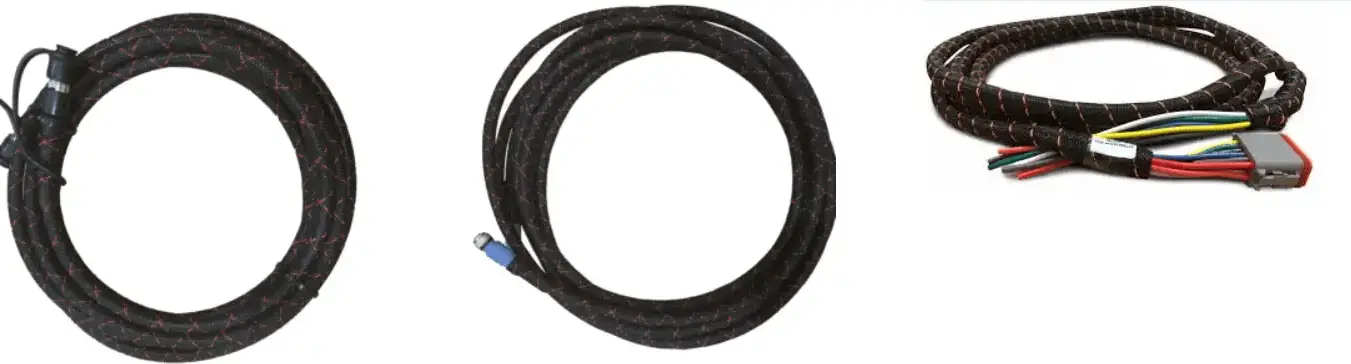
Made to the machine, not to a catalogue. Correct length, correct connector on each end, braided over the full run. A harness that fits does not need to be coiled, taped or adapted — and those three things are where most field failures start.

In-house

We braid them ourselves

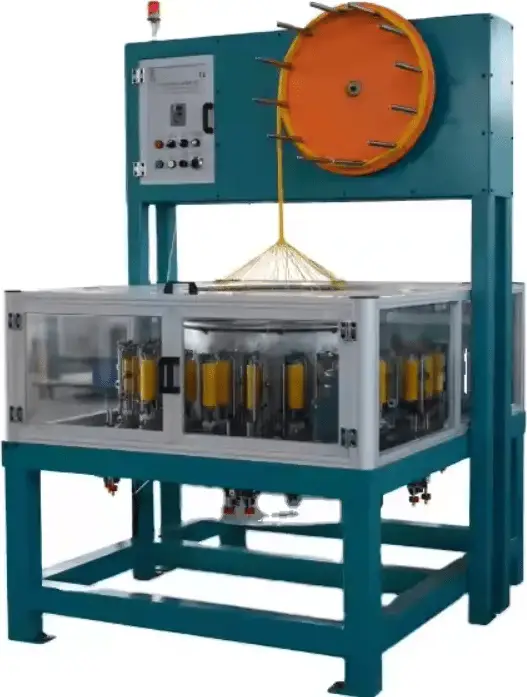
The braiding machine is in our Brisbane workshop. That is not a detail for its own sake — it is what lets us build one harness to a machine you have on the hardstand tomorrow, rather than quoting a minimum order and a lead time from overseas.
The braider. Carriers load with braid yarn and travel around the cable as it feeds through, laying an interlocking sleeve directly onto the bundle rather than sliding a pre-made sock over it.
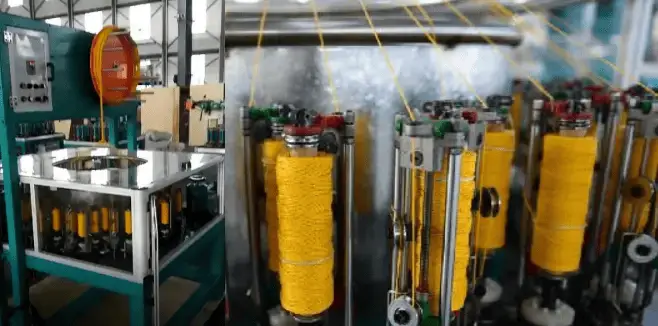
Carriers under way. Every carrier feeds one strand. Changing the carrier count, the yarn and the take-up speed changes how tight and how thick the finished braid is, which is how the same machine covers a thin sensor lead and a heavy power run.

One-offs are normal

A single harness for a single machine is an ordinary job here, not an exception we grudgingly accept. Most of what we build is one of one.

Any length

Measured to your machine and built to that. No slack to coil up behind a panel, no joins to make it reach.

Fast turnaround

Because it is made here. Tell us what you need and when the machine is available and we will give you a real date, not an indicative one.

Be clear on this

Braid is abrasion protection. It is not waterproofing.

This is the most common misunderstanding about braided harnesses, and it matters, because a customer who believes the braid is keeping water out will not check the thing that actually is.
Braided sleeve compared with spiral wrap, convoluted conduit and heatshrink Four cable protection methods shown in cross section with what each one is for. Braided sleeve and spiral wrap are open and do not seal. Convoluted conduit is closed but not sealed at its ends. Adhesive-lined heatshrink is the only one of the four that seals. PROTECTION IS NOT SEALING Braided sleeve Abrasion, cut and UV Open weave Spiral wrap Light chafe, bundling Open spiral Convoluted conduit Impact and abrasion Not sealed Adhesive heatshrink Sealing a termination Seals A braided sleeve is an open weave. Water and dust go straight through it. That is not a flaw — it is what lets the bundle flex and dry out. Sealing is the job of the connector, the wire insulation and the boot at each termination. Anyone selling you braid as weatherproofing has it wrong.
Four different jobs. Braid and spiral wrap take abrasion. Conduit takes impact. Only an adhesive-lined heatshrink boot at the termination actually seals. Specifying the wrong one is how a harness looks well protected and still fills with water.

A braided sleeve is a woven, open structure. Water runs through it and dust sits in it. What it does is take the wear that would otherwise go into the cable jacket — rubbing on a bracket, dragging over a track frame, catching on a burr — and it shields the cable underneath from direct sun.

Keeping water out of a circuit is the job of sealed connectors, correctly crimped and seated terminals, cavity plugs in the unused positions, and the right boot at each termination. We do that part properly because it is the part that actually determines whether the harness survives a wet season.

Failure modes

Four ways a harness dies, and what fixes each

Where a machine harness actually fails A harness run from a cab display to a boom sensor, with four common failure points marked: chafe where the loom crosses an edge, water sitting in the back of a connector, flex fatigue at a pivot, and vibration fatigue at a termination. Braid addresses the chafe. The rest depend on the connector and the crimp. Cab display Sensor Chafe at an edge Braid solves this Water in the connector Seal, boot, crimp Flex fatigue at a pivot Routing and slack Vibration at the termination Strain relief Braid fixes one of these four. The other three come down to the connector you chose, the quality of the crimp, and how the loom was routed and supported. A beautifully braided harness with a bad crimp still fails — it just fails somewhere you cannot see.
One of four. Braid deals with chafe. Water ingress, flex fatigue and vibration at the termination are decided by the connector, the crimp and the routing — which is why we treat those as part of the harness rather than as someone else’s problem.
We would rather tell you this than sell you braid. If your harnesses are failing at the connector or the crimp, more braid will not help. Send us one that has failed and we will tell you what actually killed it, even when the answer is that you do not need what is on this page.

What we build

Harnesses for the systems we support

Most of our work is for the equipment we also supply and install, which means we know what the loom has to do rather than working from a wiring list alone.

Machine control

Sensor networks, mast and antenna runs, display and controller connections for excavator, dozer and grader systems.

GNSS and antenna runs

Antenna leads and receiver connections, routed to keep coax away from the pinch points that quietly degrade a signal.

Safety systems

Height and slew limiters, proximity detection and camera systems, including the valve and sensor runs down the boom.

Cameras and monitors

Multi-camera runs on haul trucks, loaders and service vehicles, where the cable is exposed for its whole length.

Power and switching

Fused supply runs, isolators and switch panels, sized to the load rather than to whatever was on the shelf.

Repairs and remakes

Send us a failed loom and we will rebuild it — often better than the original, because we can see how it failed.

Specification

What goes into one

Every harness is specified for the job. Talk to us about the environment and the load and we will tell you what we would use and why.

Braid

Expandable braided sleeving, selected for the run. Polyester is the general-purpose choice for outdoor plant because it holds up under UV; nylon is more flexible; aramid is available where a run takes genuinely punishing abrasion.

Tell us where the cable rubs and we will pick accordingly rather than braiding everything the same way.

Connectors

Sealed heavy-plant connectors as standard — Deutsch DT and DTM are the common choice on machines, with sealed multi-pin types where the pin count or current demands it.

Cavity plugs in every unused position. An unplugged cavity is an open path into the back of a connector, and it is one of the most common causes of a harness that fails a year later.

Cable and terminations

Conductor size chosen for the current and the length, not just the current. Crimped with the correct die, not soldered into a vibrating machine, and strain-relieved at every termination.

Labelling and documentation

Ends labelled so the next person can work out what plugs in where without tracing it. Ask us for a wiring schedule with the harness and you will get one — it is the difference between a five-minute diagnosis and a day of guessing.

How it works

From measurement to fitted

01

Tell us the machine and the run

Make, model, what is being connected, and where the cable has to go. A photo of the intended route is worth more than a description. If we already support the system on that machine, we may have the route worked out already.
02

Measure properly

Measured along the actual route with the boom or articulation at full travel, not point to point. A harness that is correct at rest and short at full reach is a harness that will be pulled out of its connector.
03

Build and braid

Cut, terminated, braided and finished in our workshop. Ends labelled, cavities plugged, strain relief fitted.
04

Test before it leaves

Continuity and pin-out checked against the schedule on every harness. This catches the transposed pair that would otherwise be found by a technician on a mine site four hours from anywhere.
05

Fit it, or send it

Our technicians can install it with the system, or we ship it to you with the schedule. Routing advice comes either way — the best harness in the world still fails if it is cable-tied across a pivot.

Questions

Frequently asked

No. Braided sleeving is an open weave — water passes through it. It protects the cable from abrasion, cutting and UV. Water is kept out of the circuit by sealed connectors, correct crimps, cavity plugs and boots. If a supplier tells you the braid is the weatherproofing, ask them what the connector is rated to.

A single harness is a normal job. Most of what we make is one of one, for one machine. That is the main reason we braid in-house rather than buying looms in.

Yes, and we would like to see it. A failed loom tells us where the machine is hard on cable, which usually means the replacement can be routed or specified better than the original. Send it in.

No. We build for the systems we support most often because that is where the demand is, but a harness is a harness. Tell us what it connects and we will quote it.

Sealed heavy-plant connectors, most often Deutsch DT or DTM, with other sealed types where the pin count or current requires it. If your machine or system needs a specific connector to mate with something existing, tell us the part number and we will match it.

It depends on the harness and what is on the bench, but because it is made here rather than ordered in, we can usually give you a firm date when you enquire. Ask, and we will tell you honestly rather than quoting a standard lead time we might miss.

Yes — ask for one. Ends are labelled as standard, and a pin-out schedule makes the next fault far quicker to diagnose. It is worth having in the machine file.

Yes, across Australia and New Zealand. Harnesses ship from Brisbane, and our technicians install on site.

Send us the machine and the run

Make and model, what is being connected at each end, and a photo of where the cable has to go. That is usually enough for us to quote a harness that fits properly the first time.
Phone
Based in
Brisbane, Queensland
Servicing
Australia & New Zealand